Tonight we went to an art opening downtown. Our dear real estate agent is the president of the Art Association. He asked us to come. He said there would be a nice set up of cheese and fruit (he knows me).
I always think we don't know anyone around here, having lost most of our friends from the school days of our children. And I feel extremely alienated among the upper-class Trump voters who are the culture vultures here. But in a small town, one knows many people. Even recluses like Tom and me. The artist for instance: he is excellent and I have long admired his work. But I have a little spot of resentment, from something almost 20 years ago. The artist is somehow affiliated with the Benedictine Monastery nearby. I was teaching a Shakespeare course at the seminary college there. He and another older fellow sat in on the first two sessions--looking extremely bored and almost contemptuous. They threw me off my stride. Of course, they voted with their feet and never returned...
I saw two people we know from school. And a very good artist/teacher who retired some time ago. From afar, I saw a New Orleans cultural bigwig, who always surprises me--he remembers me from a brief period when he ran an Arts Administration program at our school. That memory for people must be why he is so good at his job--in the stratosphere of New Orleans musical culture.
Best of all, I ran into a former student--she is about my age. She must have been in my class more than 20 years ago. A few years ago, I saw one of her pieces in a gallery. It was outstanding! And then there she was. I was surprised that she remembered me. And she was surprised that I remembered her. I run into her now and again.
Tonight she asked me when I planned to retire. I must have started stuttering...something or other. She told me I should rechannel my creativity and recommended a book called "The War of Art," which is about overcoming resistance to creativity. She suggested that I teach something at the Art Association in retirement. And recommended that I start journaling. Hence this little piece of writing.
I mentioned that idea to my pal the President of the Art Association. He said "Why not do something on poems that are about works of art, like "Ozymandias?" This guy is a fount of unexpected knowledge. We told him that such poems are called "ecphrastic." He is always happy to learn a new word (we had a little tiff recently about the meaning of "penurious"--we were both right.)
I remembered an essay that blew me away in college: "Ecphrasis and the Still Moment of Poetry, or Laocoon Revisited" by Murray Krieger. I found the article because it was mentioned in a footnote in a book by Rosalie Colie, a critic whose works taught me so much about how to read and set me on a path to studying the English Renaissance. Those kind of accidental discoveries--in footnotes, in a book NEXT TO the book you were seeking on a library shelf--were the hallmark of my studies in the days before the internet. And thank God for that, because my students tend to do internet searches for the EXACT thing they are writing on, and seldom if ever wander down the meandering paths of literature and essays on literature . . . and on other things.
So Ozymandias, Ode on a Grecian Urn, the shield of Achilles, that poem by Auden about the Brueghel painting ("Musee des Beaux Arts")--I'm sure I'll think of some others.
Thanks to Maggie for setting me down this meandering path of memory.

Custom Search
Showing posts with label creativity. Show all posts
Showing posts with label creativity. Show all posts
Saturday, September 8, 2018


Sunday, September 14, 2014
How I Ended Up with a Wedding Dress and What Will Become of It: Tales from the Thrift Store
A while ago, I was at one of the two thrift stores I frequent. There was a huge rack of used wedding dresses at ridiculous prices (high ones, that is). Needless to say--having already done a wedding in a green dress at the courthouse--I did not give them more than a glance.
The employee asked me if I wanted a wedding dress. I said no, for the above reason. He said We'll never sell them and they are taking up a lot of space. You can have them for $3 each.
I felt a bit sorry for him. So I picked out JUST ONE, figuring I could perhaps take it to the Buffalo Exchange for Halloween. I took a silk one and thought that the creative and handy Miss Em could use the fabric for something. Two possibilities.
Miss Em and I asked at the Buf. No, they didn't want wedding dresses for Halloween. Miss Em thought the dress was too nice to cut up. We put it in the DONATE pile.
Then--the fateful sentence: Maybe I'll try this on. Then an exclamation: It fits perfectly.
We put it back in the DONATE pile. Miss Em is not planning a wedding at the moment and she's sufficiently contrarian to NOT want a traditional white dress.
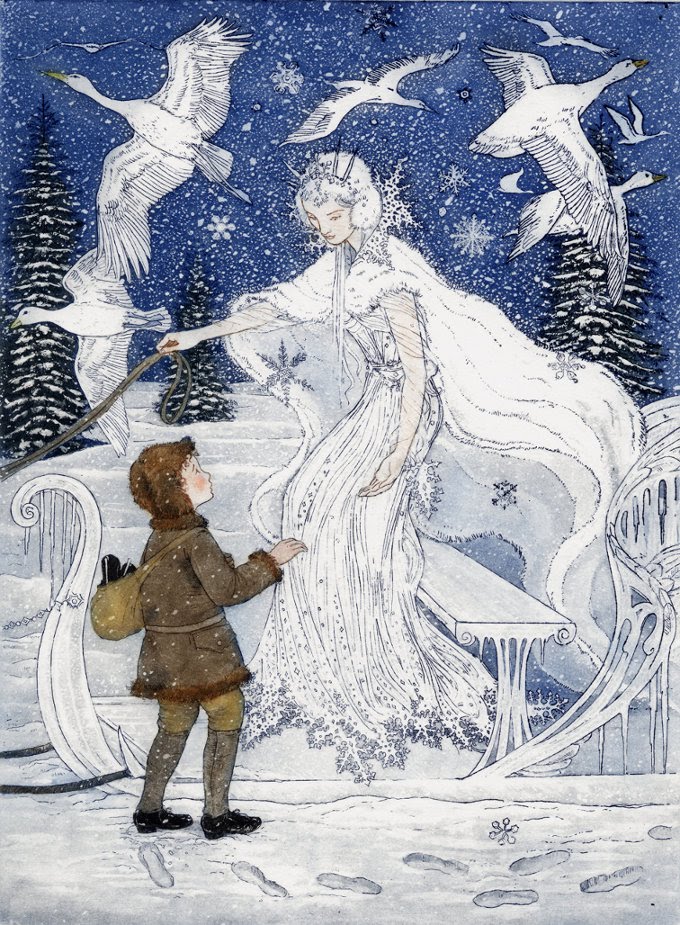
An hour later, another fateful sentence: I've always wanted to make a Snow Queen costume for Halloween.
No, I am not allowed to post a photo. (Below from Once Upon a Time wiki)
| The Snow Queen |
 |
|---|
Tuesday, October 15, 2013
Pork and Potato Hash and Some Snippets from Serbia
I want to write about some easy veggie-centric recipes for the busy Pseu, but I MUST GET RID OF THIS PORK. I am sick of it. Here's what I'm having, from another favorite cookbook: Jacque Pepin's Cuisine Economique. Isn't that a great title? This is copied from an appearance in the New York Times.
TOTAL TIME50 minutes
COOK TIME 30 minutes PREP TIME 20 minutes
INGREDIENTS
1 3/4 pounds all-purpose potatoes, peeled, cut into 1/4-inch slices and washed in cold water
1 1/2 cups water
3/4 pound onions (about 2 medium-size onions), peeled and cut into 1/2-inch dice
A few tablespoons of juice left over from the pork roast, if any remains (see recipe)
3 to 4 cloves garlic, peeled, crushed and chopped (about 1 tablespoon)
1/3 cup minced scallion (3 to 4 scallions)
3 tablespoons olive oil
1/4 teaspoon Tabasco sauce
3/4 teaspoon salt
2 teaspoons Worcestershire sauce
10 to 12 ounces leftover pork roast (see recipe), cut into 1/2-inch dice (about 2 1/2 cups)
1 fried egg, for garnish (optional)
PREPARATION
1.
In a 12-inch nonstick skillet (or 2 smaller nonstick skillets), place the sliced potatoes with the water, onion and juice from the pork roast. Bring to a boil, cover and boil over medium heat for 10 minutes. Then add the garlic, scallion, olive oil, Tabasco, salt, Worcestershire sauce and the leftover pork roast. Mix well and cook, uncovered, stirring over high heat for about 5 minutes.
2.
Most of the moisture will have evaporated by now and the mixture should start to sizzle. Since the hash will begin to stick at this point, use a flat wooden spatula to scrape up the crusty bits sticking in the bottom of the pan and stir them into the uncooked mixture. Continue to cook over medium heat for about 20 minutes, stirring every 3 or 4 minutes. The mixture will brown faster in the last 10 minutes of cooking and should then be stirred every 2 or 3 minutes.
3.
At the end of the cooking time, the mixture will stop sticking to the pan. Press on the mixture to make it hold together and fold the solid mass into an oval omelet shape. Invert onto a large platter. Serve immediately as is or with one fried egg on top.
YIELD 6 servings
The book is neat: Pepin explains that his classical French training has been jazzed up by the influence of his Puerto-Rican born wife. Yay Gloria! Love the hot sauce. Another book that can be had for a penny plus shipping.
In the doting mom department: take a look at Miss Em's snippets from Serbia. I think they are charming, but then, I'm biased.
Wednesday, February 11, 2009
Creativity and Frugality: Personal and Poetic Ties
The third post featuring the creations of the late mother-in-law of Frugal Scholar. Below is a coat made of ties. Clothing made of ties is nothing new: I remember reading an interview with Jane Gallop, an academic provocatrice (is that a word?), where she spoke of wearing a skirt of ties reputed to have been gathered from her sexual conquests. She refused, if I remember correctly, to confirm or deny those rumors.
These ties belonged to the late Henri Coulette, the closest friend of my father-in-law, who recently celebrated his 90th birthday. Henri died at age 61 in 1988. He was divorced and had no children. As I recall, a battle over his estate ensued; fighting it out were his ex-wife and a nephew, whom he had never met. Presumably, a Bleak House scenario followed. My father-in-law loved Henri and gathered these ties that no one wanted. Henri was known as a spiffy dresser. My mother-in-law made this coat from some of them.
Mr. DFS and I knew Henri was a poet. We looked him up on-line and learned that he suffered the tragic and accidental destruction of his second book. Here is a bit of what we learned:
Henri Coulette has the odd distinction of enjoying a cult, or underground reputation as an exemplar of what is often considered the most conservative mainstream of American poetry, the form-conscious, ironic academic poets of the 1950s, strongly influenced by the New Critics. Coulette's career foundered after the bizarre and accidental destruction of nearly every copy of his second book, but because of support from important admirers, and the resurgence of formalism in the 1980s and 1990s, he has come to be regarded as a poet's poet.
For more, see www.opus40.org/tadrichards/HCouletteGW.html

Back.

Tuesday, January 27, 2009
Mother's Sweaters: Frugality and Art
By Mr. Dr. Frugal Scholar
My mother was an indefatigable and creative knitter. She grew up with the early notions of frugality, which emphasized making stuff one needed, rather than trying to find new, inexpensive things to buy. She made almost all of her clothes, though she let us buy ours, and she built all our brick walks and stone walls, among other things.
But one of her real passions was knitting. This was partly because she could do it while reading. She was a fast and voracious reader, but I think she always felt that she should be doing something else as well—that “just” reading wasn’t sufficiently productive. (She and Ben Franklin would have gotten along very well.) My father built her a beautiful book stand so that she could knit and read at the same time.
She mostly knit sweaters (though once she made a 35 foot scarf—“for a giraffe,” she insisted). Although she could and did execute complicated patterns, her real passion was for creative combinations of various textures and colors, and no two of her sweaters came out the same. She would hunt out balls of yarn that had been discounted because there were only a few left—not enough to make a sweater, and so not worth much to most knitters. (Dr. Frugal Scholar scouted for her in Louisiana, and we still have a box of yarn in our closet that we never brought her.) She would use these remnants to make sweaters that were real works of art.
She also made other objects of what I suppose one would call art clothing, including a jacket made from zippers that she got a great deal on, and another constructed from the dozens of silk ties no one claimed when a good friend of my father died.
But her real passion, as I said, was sweaters. I’m not sure how many she knit; I know that she donated about 30 to be auctioned off to raise money for the Bandon, Oregon library. Others were given away, or auctioned off to support other charitable enterprises. There were really many more than she could possibly wear, but I don’t think that “use” was the motivation; knitting satisfied needs beyond utility, even though this might have been her overt rationale, and probably appeased her frugal conscience.
I took photos of some of the ones that we still have, and I’d like to offer a sample here, as a record of what can be made with the orphaned balls of yarn no one else wanted. So when I try to use every bit of my Meyer lemons, in some way I’m following in the footsteps of my mother.

Wednesday, December 31, 2008
Leftovers and Painted Cactuses


One of the challenges of frugal living is what to do with all those leftovers. Food isn’t a problem (at least for this family, although I’ll let Ms Dr. FS tell you why). But what about those bits of paint that are always left after a project is done? Of course one’s temptation is to put the lid on tightly and stow the can in the garage until . . . . well, usually until it dries out and gets thrown away. (Yes, I’ve tried caulking the top, and a dozen other methods, none of which has been foolproof.)
If you can’t save it, use it. (This is also the basic principle behind leftovers, by the way.) My late father-in-law Bert had a wonderful way of using up leftover paint which shows not only his own creativity, but proves that creative frugality can thrive in even the most hostile environments. By which I am thinking of the cookie-cutter communities of
My in-laws’ development does not exactly encourage variety or distinctiveness; uniformity is not only expected, it is enforced. A few years ago a number of residents started to add little cutesy things to the tops of their mailboxes—gnomes, miniature golf bags, artificial flowers, etc.—a touch of the individual to make their condominiums easier to find among the proliferating sameness. This was ruled in contravention of the community’s rules, and now the mailboxes are all nice and clean and interchangeable again.
But Bert found a solution that not only made his condo easier to find, but beautified the landscape and used up all the bits of paint he’d accumulated: he painted the cactuses.

The result is what I think is a real work of folk art. (Note the strategic placement of unused nails.) How it has managed to survive the scrutiny of the powers that be is beyond me, although I suspect that they simply didn’t want to mess with anyone who paints his cactuses. He could be dangerous.
Sunday, November 16, 2008
My frugal Dad: wastepaper basket
My frugal Dad
In Memoriam: BG 1928-2008
My father died unexpectedly last week, just a few days after a doctor told him that, with his strong heart, he could look forward to 10-15 good years with my mother.
My dear and difficult father taught me to be frugal, though I probably surpass him in the pathological department. There are many ways to be frugal: save money on things you need, don’t buy things you don’t need, make things yourself, make do, and many more. My dad was also a fearless manager of his own money, and it is a tribute to his skills that, after years of owning a small business, followed by 12 years of teaching, and NO pension or inheritance, my mother is OK for money, even after the dreadful downturn of late.
My first tribute will be a small one. Although it was not his strongest frugal suit, my father did have a streak of creative frugality. When my husband and I were helping out my mother by emptying a small trashcan by my father’s desk, we discovered that he had lined the mesh trashcan with….a collage of used tyvec envelopes from priority mail. That’s creative, and frugal, and good for the earth…all at once.
Thanks for the unexpected moment of pleasure in the midst of sadness.
Subscribe to:
Posts (Atom)


 Posts

